



Ankush singh
One of the most daring intelligence operations of the Cold War unfolded in secret after the Soviet Union lost a nuclear-armed submarine in the Pacific Ocean in 1968, prompting the CIA to launch a covert mission to recover parts of the vessel from nearly five kilometres beneath the sea, according to international media reports and declassified US intelligence records.
The Soviet submarine K-129 disappeared on March 8, 1968, during a routine patrol mission in the North Pacific Ocean. The diesel-electric Golf II-class submarine had departed from the Soviet naval base at Rybachiy in Kamchatka carrying three R-21 ballistic missiles equipped with nuclear warheads.
Commanded by Capt. Vladimir Kobzar, the submarine had a crew of 98 sailors. Its mission reportedly involved patrolling waters near Hawaii during a period of heightened Cold War tensions between the United States and the Soviet Union.
The disappearance triggered a major Soviet search operation involving warships and reconnaissance aircraft, international media reports said. However, despite weeks of searching, Soviet forces failed to locate the submarine or determine what caused it to sink.
Unknown to Moscow, the United States had already detected signs of the disaster. According to reports citing former US intelligence officials, America’s secret Sound Surveillance System, known as SOSUS, recorded an underwater acoustic event believed to be linked to the submarine’s loss.
US intelligence agencies closely monitored Soviet search activity and concluded that the Soviet Navy had lost a strategically important submarine carrying nuclear weapons.
The CIA soon began exploring the possibility of locating and recovering the wreckage. The mission was viewed as an opportunity to obtain Soviet military technology, cryptographic material and intelligence linked to the USSR’s nuclear capabilities, according to declassified documents and international media reports.
The operation to locate the submarine was codenamed Operation Sand Dollar. Using underwater surveillance data and advanced sonar technology, the US Navy identified the wreck site about 1,560 miles northwest of Hawaii near the International Date Line.
The specially modified spy submarine USS Halibut was deployed to photograph the wreckage at a depth of around 16,000 feet. International media reports said US analysts examined thousands of underwater images before confirming that large sections of K-129 had been found scattered across the seabed.
The discovery led to an even more ambitious CIA plan known as Project Azorian.
The agency sought to raise a large section of the submarine from the ocean floor in complete secrecy. The mission posed enormous engineering and political risks because no object of such size had ever been recovered from such depth.
To conceal the operation, the CIA created an elaborate cover story involving billionaire businessman Howard Hughes. Publicly, Hughes was said to be financing an experimental deep-sea mining project designed to extract manganese nodules from the ocean floor.
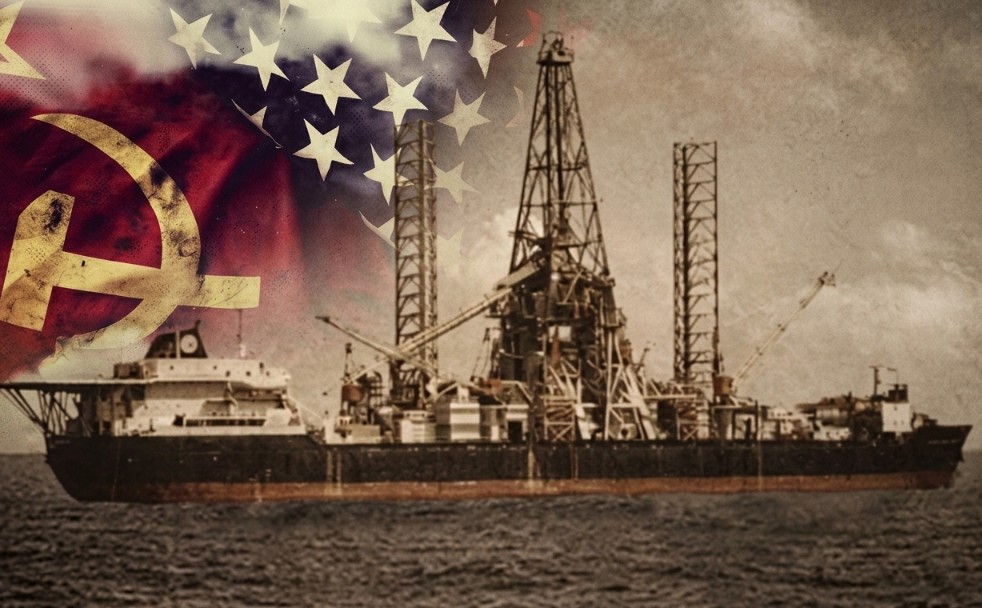
Behind the cover story, a giant vessel called the Hughes Glomar Explorer was constructed. The ship appeared to be a commercial mining platform but secretly contained sophisticated recovery equipment designed to lift the submarine wreckage.
The vessel featured a hidden compartment known as a “moon pool”, through which a massive mechanical claw nicknamed Clementine could be lowered deep into the Pacific Ocean without being visible to outside observers.
Construction of the vessel and its specialised equipment reportedly took several years and cost hundreds of millions of dollars, according to international media reports.
Following approval during Richard Nixon’s presidency in the early 1970s, the Hughes Glomar Explorer arrived above the wreck site in July 1974 and began the recovery operation under intense secrecy. Crew members posed as civilian mining workers while CIA personnel and naval experts directed the mission.
Soviet ships reportedly approached the area during the operation and questioned the vessel’s activities. However, the mining cover story prevented immediate suspicion.
After days of complex underwater work, the claw successfully attached itself to part of the submarine and began lifting it towards the surface. But during the recovery, a major mechanical failure occurred.
Large portions of the submarine broke apart and fell back to the seabed, including sections believed to contain ballistic missiles and sensitive code material.
Despite the setback, the United States reportedly recovered part of the forward section of the submarine, including two nuclear torpedoes and several intelligence-related items. The bodies of six Soviet sailors were also recovered.
According to declassified CIA accounts and international media reports, the recovered sailors were later given a military burial at sea, and the ceremony was recorded on video.
The operation remained secret until 1975, when reports published by American media exposed the mission. The revelations triggered diplomatic tensions between Washington and Moscow and effectively ended plans for a second recovery attempt.
The CIA’s response to journalists questioning the operation later became famous as the “Glomar response” a phrase used by intelligence agencies to neither confirm nor deny classified activities.
The exact cause of K-129’s sinking remains disputed and continues to be debated by historians and intelligence experts.
#ColdWar #SovietUnion #K129 #NuclearSubmarine #USSR