



Rural tourism is helping India’s villages earn more, create jobs and protect their traditions. Instead of only visiting big cities and famous monuments, travellers can now stay with a village family, tour a farm, learn a craft or taste local food.
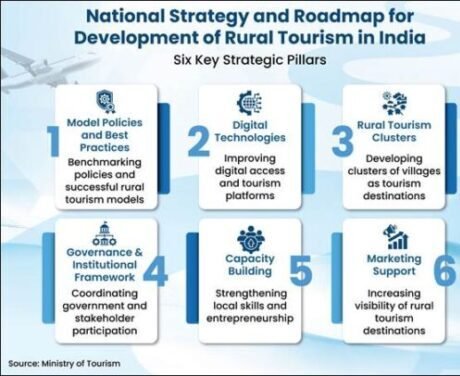
The government’s National Strategy and Roadmap for the Development of Rural Tourism, prepared in December 2021, supports this idea. It aims to build clusters of tourist villages, improve roads and facilities, promote local experiences and involve the community in every step.
For a student, think of it this way. A village that has a beautiful weaving tradition, a lively festival or a green farm now has a way to earn from these things without giving them up. Tourists get a real taste of village life, and the village gets a new source of income.
Rural Tourism Helps Families, Women and Young People Earn More
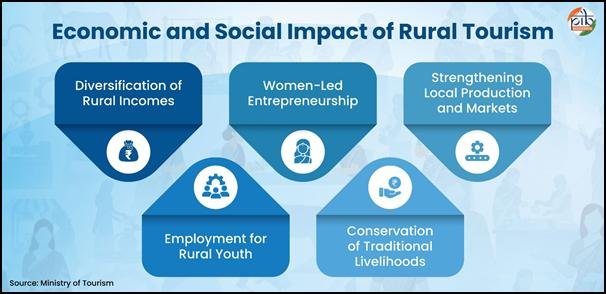
Rural tourism gives people a second way to earn besides farming. Families can run homestays, artisans can sell their crafts, and young people can work as guides, drivers or digital tourism helpers. Women gain a lot too. They can cook for guests, manage homestays or sell souvenirs through self-help groups.
Homestays show the effect most clearly.
According to India’s Tourism Satellite Account, they have the highest employment multiplier (4.38) and output multiplier (2.04) among tourism sub-sectors. Simply put, money spent on homestays creates more jobs and more business than money spent in other tourism areas. Every one unit rise in homestay output also adds 0.42 units to farm output, because guests eat local vegetables and food.
Some villages have already won global recognition. The UN World Tourism Organization chose Pochampally in Telangana in 2021 and Dhordo in Gujarat in 2023 as Best Tourism Villages.
Support Through Schemes, Loans and Training
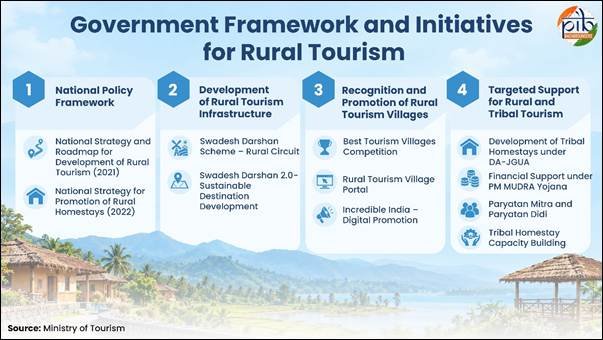
Developing tourist spots is mainly the job of state governments and Union Territories. The Centre helps through national strategies, funding, training and marketing. A second strategy, launched in 2022, focuses on rural homestays. It encourages states to give subsidies, simple online registration and training to women’s self-help groups.
Several programmes now back villages:
Swadesh Darshan: The Rural Circuit is one of 15 themed circuits. By March 9, 2026, two projects were approved, one in Bihar and one in Kerala, worth ₹101.62 crore. Of this, ₹86.19 crore was released.
Best Tourism Villages Competition: The 2024 edition received 991 applications, up from 795 in 2023. In all, 36 villages were recognised across eight categories.
Rural Tourism Village Portal: Launched on February 16, 2023, it shares details on villages and homestays.
DA-JGUA: This scheme aims to build 1,000 tribal homestays. Families can get up to ₹5 lakh for two new rooms and ₹3 lakh to renovate existing ones.
Mudra loans: Budget 2025-26 created a separate category for homestay loans.
Paryatan Mitra and Paryatan Didi: By March 2026, about 4,382 people, mostly women and youth, had been trained.
States are adding their own steps too. Sikkim is developing over 1,000 homestays under its Mega Homestay Scheme, and Goa has a simple online registration system.
Going ahead, the focus is on forming clusters of five to seven villages and promoting them online, while keeping local culture and nature safe.