



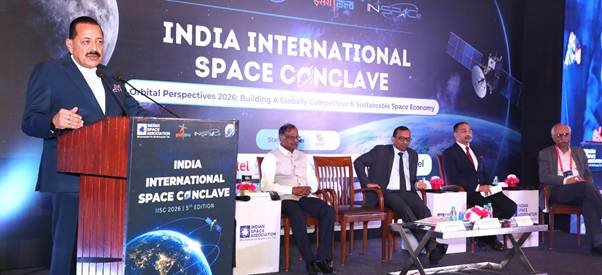
Space is no longer just the government’s playground in India. Dr Jitendra Singh, Union Minister of State (Independent Charge) for Science and Technology, said on Tuesday that the country’s space economy is worth about $9 billion today. He expects it to reach $40–45 billion in less than ten years, with private companies leading the way.
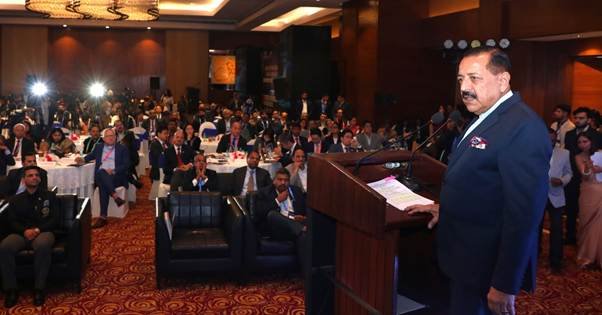
He was speaking at the fifth India International Space Conclave 2026 in New Delhi. The two-day event, held on 23 and 24 November, was organised by the Indian Space Association (ISpA). Startups, researchers, industry leaders and international guests attended. A report called “Space Economy 2036: The India Blueprint” was also released there.
Space Startups Have Grown From a Handful to 400–500 Companies
Only a few years ago, India had just a handful of space startups. Today the number is around 400 to 500. Dr Singh credited reforms under Prime Minister Narendra Modi, including the creation of New Space India Limited (NSIL) and IN-SPACe, and the decision to open the sector to private players. He called these some of the most transformative policy decisions in recent decades, because they ended a system where space work stayed mostly inside government.

He pointed to some big wins. Skyroot flew its first launch vehicle on 18 July 2026, signed a multi-mission launch deal and became a unicorn. Agnikul is building advanced propulsion systems, and other firms are working on privately made rocket engines, Earth observation and satellite imaging.
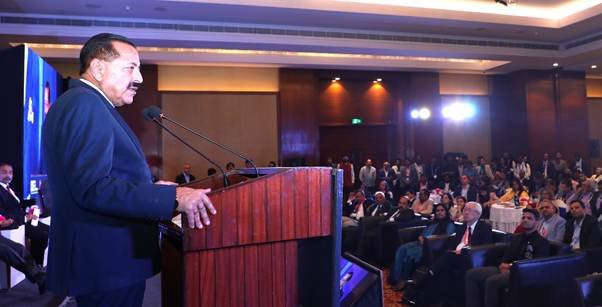
He also shared progress under the National Quantum Mission, launched in 2023. The target was 2,000 km of secure quantum communication in eight years. India has already reached 1,000 km in just three.
Space Technology Now Helps Railways, Roads and Defence
Dr Singh said the value of space technology should not be judged only by rocket launches, satellites and revenue. The savings, efficiency and better results it brings on the ground matter too. He explained that PM Gati Shakti, the national master plan for infrastructure, uses space-based tools to plan projects better, keep them on schedule, cut costs and reduce waste and leakage. Almost every ministry now uses space technology, from railways and defence to health, education and communication.
On the question of weak demand, he said the real issue is that many people do not know how useful space technology can be. He said technological self-reliance and global cooperation can go together, so India should build its own strengths while staying open to partnerships that benefit both sides.
Finally, he urged Indian companies to invest more in the sector and to bring in more foreign investment. He also asked them to use CSR funds to support research, not just machines and buildings, and to treat research funding as a real contribution to society.