



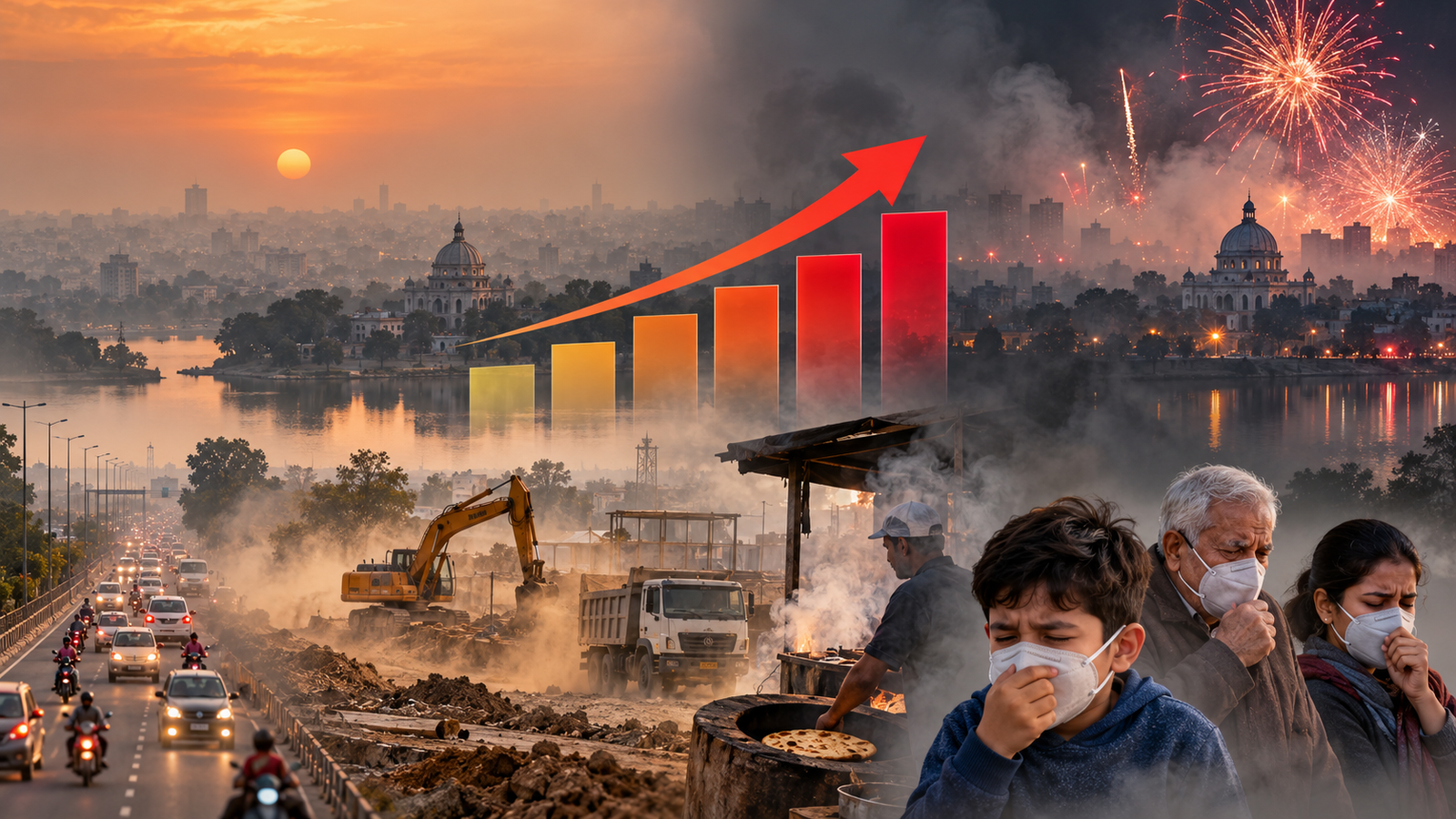
Bhopal’s air pollution follows a worrying seasonal pattern, with daily readings rising during October and reaching much higher levels in November, according to AQI calendar screenshots covering 2023, 2024 and 2025.
The figures point to growing concerns for children, older people and residents with asthma or other lung and heart conditions as the city moves towards winter.
The screenshots show that the highest daily reading in October 2023 was 357, while November recorded a peak of 465. In 2024, the highest October reading was 365, rising to 493 in November. In 2025, October reached 373, while November recorded a high of 428.
These figures suggest a recurring seasonal rise rather than a steady increase every year. The screenshots are historical app records, not independently verified daily averages from the Central Pollution Control Board (CPCB). They should therefore be treated as evidence of a pattern in the displayed readings, rather than proof that Bhopal’s pollution has increased every year.
Bhopal pollution: Why October and November matter
Several factors can combine to worsen air quality during these months. As winter approaches, lower wind speeds and changes in the height at which air mixes can prevent pollution from spreading. Cooler weather can allow pollutants to remain closer to the ground, particularly when the atmosphere is stable.
Diwali fireworks can add a sudden burst of fine particles to the air. Construction work, uncovered building materials, road digging and dust from busy roads can add further pollution. Vehicle exhaust, waste burning and smoke from fuel-burning cooking equipment, including traditional tandoors, may also contribute.
Humidity can affect particle formation and how pollution behaves in the air, but it should not be described as the sole cause of rising AQI. The size of each source’s contribution depends on local conditions and requires scientific measurements to establish.
A study of Bhopal’s traffic-related air pollution has also highlighted how vehicle emissions and congested roads can worsen exposure for people working or living close to busy streets. Research on the city’s air pollution has identified the role of weather and fuel combustion in the build-up of fine particles.
Bhopal pollution: PM2.5 and PM10 pose major concerns
The pollutant labels visible in the screenshots frequently identify PM2.5 and PM10. Both are important, but they behave differently.
PM10 includes inhalable particles such as road dust and construction dust. PM2.5 consists of much smaller particles that can travel deep into the lungs, and some can enter the bloodstream. These particles can worsen asthma, trigger coughing and breathing difficulties, and increase the risk of heart and lung problems.
A 2026 report submitted by the Madhya Pradesh Pollution Control Board to the National Green Tribunal identified road dust and vehicle emissions as major pollution sources in Bhopal. Construction activity and waste burning are also concerns. However, the screenshots alone cannot establish which pollutant is the biggest contributor across the city throughout the year. The pollutant responsible for the highest AQI can change from day to day.
Bhopal pollution: What AQI levels mean for health
Under India’s national AQI scale, readings of 101–200 fall in the moderate category, 201–300 are poor, 301–400 are very poor, and 401–500 are severe. The CPCB warns of increasing breathing discomfort as the index rises, with children, older adults and people with existing illnesses among the groups that need greater protection.
For a simple comparison, Berkeley Earth estimates that a daily average PM2.5 concentration of about 22 micrograms per cubic metre is roughly equivalent to the health impact of smoking one cigarette per day. Applying that method to estimated PM2.5 concentrations associated with specific Indian AQI values gives the following rough comparisons:
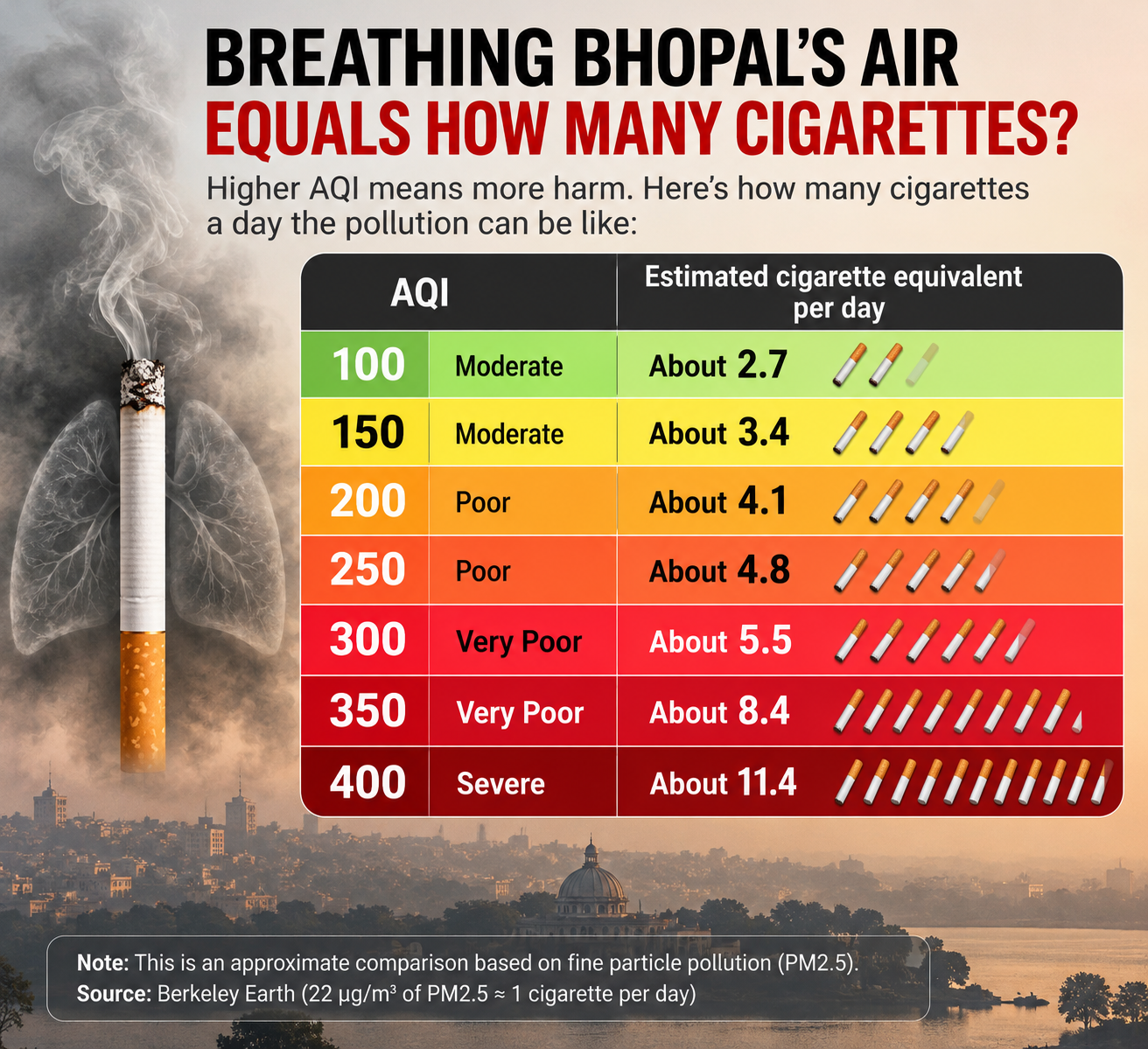
Important: These are illustrative estimates, not direct conversions of AQI into cigarettes. They assume PM2.5 is the pollutant determining the index and use the Indian AQI breakpoints to estimate its concentration. The comparison does not mean breathing polluted air is identical to smoking, and it should not be used to calculate an individual’s personal health risk.
Bhopal pollution: Children and older people need protection
Children’s lungs are still developing, while older people and those with asthma, heart disease or other chronic illnesses can be more sensitive to polluted air. Exposure may cause coughing, wheezing, throat irritation and breathing discomfort. Fine particles can also contribute to more serious respiratory and cardiovascular illness.
Residents can reduce exposure by limiting strenuous outdoor activity when air quality is poor, keeping children away from heavy traffic and construction dust, and following official health advisories. People who experience severe breathing difficulty should seek medical attention.
Bhopal pollution: The October 2026 picture remains incomplete
The October 2026 screenshot shows readings ranging from 93 to 137 for October 1–24, with the highest displayed value of 137. The remaining dates are marked as unavailable. This is substantially below the October peaks shown for 2023, 2024 and 2025, but it does not establish how the full month or the coming November will compare.
The key concern is whether Bhopal can prevent the familiar seasonal build-up from becoming another period of prolonged poor air quality. Better road-dust control, construction-site enforcement, cleaner transport, prevention of open waste burning and responsible firecracker use can all help. Regular monitoring and transparent reporting of pollutant concentrations are essential to identify the main sources and measure whether these measures work.
Also read: Tiger Shroff firing case: Suspect arrested in Indore over alleged arms supply
For more news updates, visit Vision MP.