



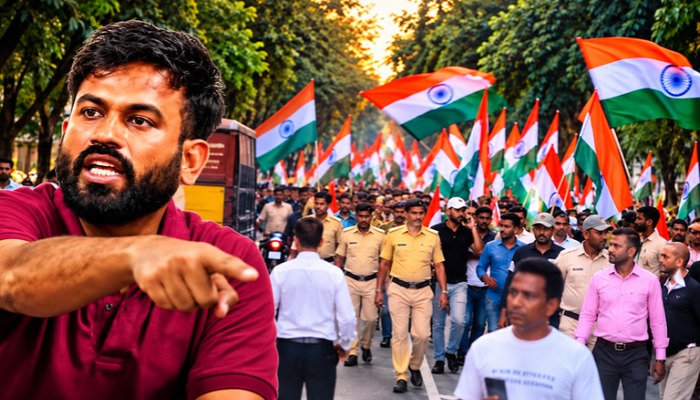
NEW DELHI: The Cockroach Janta Party (CJP) was yet to reveal its alternative strategy hours after Delhi Police detained its convenor, Abhijeet Dipke, ahead of a planned Tiranga March at Connaught Place on Friday, according to media reports.
The organisation had called for the march at Central Park at 5 pm to protest against the Special Intensive Revision (SIR) of electoral rolls and demand the removal of Chief Election Commissioner Gyanesh Kumar.
Police personnel visited Dipke’s residence in Jhandewalan earlier in the afternoon and served him a notice directing him not to participate in the march, citing restrictions under Section 163 of the Bharatiya Nagarik Suraksha Sanhita (BNSS).
Dipke left his residence at about 4.50 pm to travel to Connaught Place but was detained by police shortly afterwards. Some protesters attempted to block the vehicle carrying him away. Dipke questioned the legality of his detention, while police described the action as preventive.
Before his detention, a CJP representative said the organisation had prepared a Plan B and would announce an alternative strategy if police prevented Dipke from reaching the venue.
The contingency arrangements followed a similar episode on October 10, when Dipke and two other CJP leaders, Saurav Das and Ashutosh Ranka, were detained during a protest in Delhi. Ajinkya Shinde was subsequently named to lead the movement in their absence.
Security was tightened across Connaught Place, with barricades and police vehicles restricting access to Central Park. Personnel from Delhi Police, the Central Reserve Police Force and the Rapid Action Force were deployed in the area.
Several protesters, including members of Left organisations and All India Students’ Association chief Neha Bora, were also detained, according to media reports.
Despite the CJP’s announcement, its Plan B had not become clearly visible on the ground hours after Dipke’s detention. Protesters gathered in scattered groups, raising slogans, while police asked them to disperse.
The gathering remained largely peaceful, but protesters were not allowed to enter Central Park. The developments raised questions about the CJP’s ability to sustain its mobilisation without its senior leaders.