



NAVED ALAM
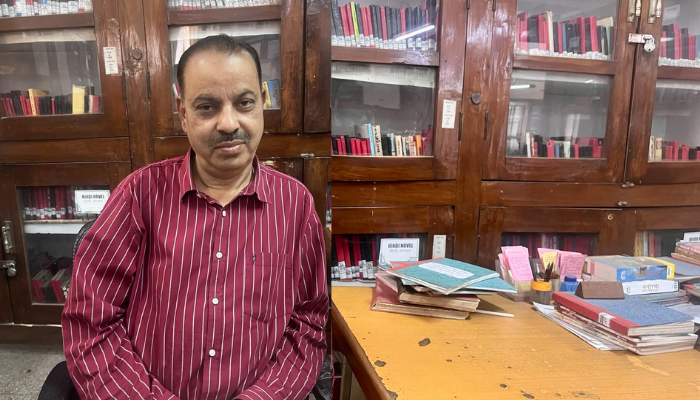
The library near Sultania Road does not draw attention to itself. It sits quietly in old Bhopal, folded into a row of buildings that carry on with their own rhythms. Inside, the light is dim, the shelves are steady with age, and a ceiling fan moves the air just enough to suggest that time has slowed.
Behind a desk, Rafi Shabbir looks up briefly when someone enters, then returns to his book. There is no urgency in the gesture. He has been here for nearly a decade, long enough to know that most days will pass like this. He is not waiting for the room to fill.
“I observe people,” he says.
He grew up in old Bhopal, in a neighbourhood where lives overlapped and conversations travelled easily. He studied in government schools, went on to government colleges, and became one of the first in his family to continue beyond the expected path. There is no sense of arrival in the way he speaks about it, only movement from one phase to another.
Before the library, there was painting. The gas disaster stayed with him, not as an event to be recorded, but as something that altered the emotional texture of the city. He painted what he could not fully explain, and later turned to writing, finding that words allowed him to stay closer to what he observed.
His plays draw from everyday life. A turn of phrase, a pause in conversation, the way humour softens discomfort in old Bhopal. The characters feel familiar because they are.
“Books give knowledge, but interaction gives depth,” he says.
The library offers both, though not in equal measure. There are books, but fewer readers than there once were. Some come for newspapers, some for examinations, and some for reasons that are difficult to name. Shabbir does not measure their presence. He notices patterns.
He can tell who reads to pass time and who reads to understand it.
His work in theatre has been sustained and prolific, with dozens of Urdu plays shaped by an ear for everyday speech. Dialogue, for him, must sound lived, not written, drawn from the cadences of old Bhopal.
He has also translated Urdu poetry into Hindi, moving between languages with ease. The practice has sharpened his attention to nuance, where meaning shifts subtly with words, and where listening becomes as important as reading.
Outside, the city has shifted towards faster ways of knowing. Information arrives quickly, often without effort. He does not reject it, but he does not trust it entirely.
“People are moving towards information rather than knowledge,” he says. “Reading allows you to think for yourself.”
At home, he lives in a joint family and is its eldest member. His father worked in the municipal corporation, his mother managed the household. One of his sons works in artificial intelligence, the other is still studying. He does not frame this as contrast. It is simply how time rearranges itself across generations.
The library remains constant. He intends to stay here until retirement because it allows him to continue the only practice he seems to value consistently — paying attention.
“Everyone has the same 24 hours,” he says. “It depends on how you use them.”
In his case, those hours are not filled so much as observed. The library may not draw crowds, but it holds a quiet record of a city that still reveals itself in small, unguarded moments.