



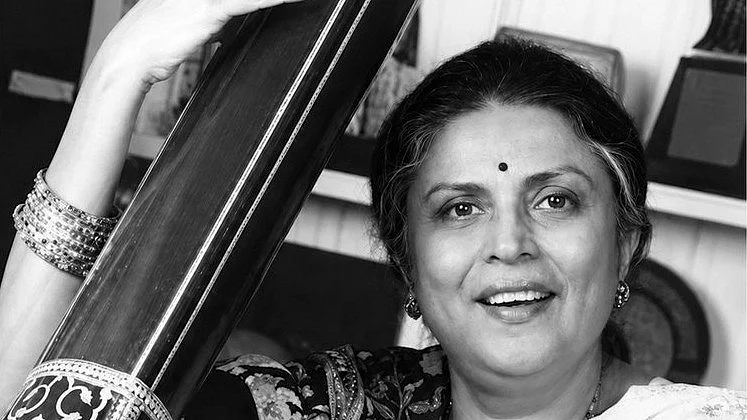
Veteran playback singer Suman Kalyanpur, whose melodious voice defined an era of Indian cinema music, passed away in Mumbai on Sunday evening at the age of 89. She was accorded a state funeral on Monday at Pawan Hans crematorium.
According to family friends, Kalyanpur breathed her last at around 8 pm following age-related health complications. She is survived by her daughter, Charu.
The singer was honoured with the Padma Bhushan in 2023 for her contribution to Indian music. Over a career spanning several decades, she recorded more than 3,000 film and non-film songs in 11 languages, earning admiration across generations of music lovers.
Prime Minister Narendra Modi paid tribute to the singer, describing her voice and expressive singing as a significant contribution to India’s cultural heritage. In a condolence message, he said her songs had secured a special place in the hearts of music enthusiasts and cinema audiences alike.
“Anguished by the passing of the popular singer Suman Kalyanpur Ji. Her melodious voice and soulful renditions enriched our cultural world. Through her songs, she created a special place among music lovers and admirers of Indian cinema. Condolences to her family and admirers. Om Shanti.”
Anguished by the passing of the popular singer Suman Kalyanpur Ji. Her melodious voice and soulful renditions enriched our cultural world. Through her songs, she created a special place among music lovers and admirers of Indian cinema. Condolences to her family and admirers. Om… pic.twitter.com/xCGswIq0s6
— Narendra Modi (@narendramodi) June 1, 2026
Kalyanpur rose to prominence during the 1960s and 1970s, carving out a distinct identity in an era dominated by some of Indian cinema’s greatest playback singers. Her most celebrated songs include Aajkal Tere Mere Pyar Ke Charche, Na Na Karte Pyar Tumhi Se and Tumne Pukara Aur Hum Chale Aaye, which continue to enjoy enduring popularity.
She sang in multiple languages, including Hindi, Marathi, Bengali, Assamese, Kannada and Odia, reflecting the breadth of her musical reach.
Kalyanpur’s voice was frequently compared with that of legendary singer Lata Mangeshkar because of their remarkably similar tonal quality. The comparisons often led listeners to mistake one singer’s recordings for the other’s.
However, Kalyanpur consistently rejected any rivalry narrative. In interviews, she described Lata Mangeshkar as a close friend and recalled that meeting her always felt like meeting a companion rather than a competitor.
Her career gained additional momentum during a period when playback legends Lata Mangeshkar and Mohammed Rafi were not recording together following a professional dispute. During that time, Kalyanpur collaborated extensively with Rafi, producing several memorable duets that remain part of Hindi cinema’s golden music catalogue.
In one of her most-discussed recollections, Kalyanpur claimed that the patriotic classic Aye Mere Watan Ke Logon had originally been intended for her performance before it was ultimately sung by Lata Mangeshkar. She said the episode remained one of the most emotional moments of her career.
Despite her immense popularity, Kalyanpur maintained a private life away from the spotlight. Veteran radio presenter Ameen Sayani famously waited 45 years before she agreed to sit down for an interview in 2005.
Born with a passion for both painting and music, Kalyanpur initially aspired to become an artist. Her musical talent was recognised early by Keshavrao Bhole, who encouraged her family to provide formal training. She later trained under distinguished teachers, including Khan Abdul Rahman Khan and Master Navrang.
With thousands of recordings, a career spanning multiple languages and generations of listeners, Suman Kalyanpur leaves behind a musical legacy that remains woven into the history of Indian cinema and popular culture.
For more coverage on entertainment, culture and national developments, visit Vision MP.