



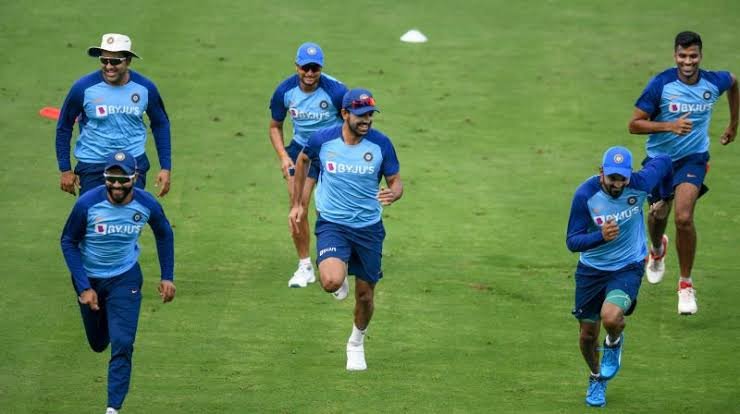
BCCI has introduced stricter fitness benchmarks for Team India players following concerns over fitness, injuries and mobility during the recent England tour, making the Bronco Test and 2km run significantly more demanding for centrally contracted cricketers.
BCCI has raised the fitness standards for India’s men’s cricket team after its Ireland and England tours, where recurring injuries and concerns over players’ on-field movement prompted a review of existing fitness protocols. Under the revised guidelines, players will have to complete the Bronco Test in 5 minutes 15 seconds to 5 minutes 20 seconds, followed immediately by a 2km run within 9 to 10 minutes, making the assessment more physically demanding than before.
BCCI Introduces Tougher Fitness Benchmarks
The revised fitness programme requires players to complete two endurance tests back-to-back instead of taking them separately. The change is aimed at assessing how well players perform under fatigue, a key factor during long international matches.
The Bronco Test, widely used by elite sports teams, consists of five continuous sets of shuttle runs covering 20 metres, 40 metres and 60 metres. Each set totals 240 metres, meaning players run 1,200 metres without any break during the full test.
Earlier, players had six minutes to complete the Bronco Test. Under the new rules, that time has been reduced by up to 40 seconds, significantly increasing the challenge.
Immediately after finishing the Bronco Test, players must complete a 2km run within 9 to 10 minutes. Previously, the 2km run was conducted as a standalone test, with fast bowlers required to finish in 8 minutes 15 seconds and other players in 8 minutes 30 seconds. Although the new time limit is slightly more relaxed, performing the run immediately after the Bronco Test makes the overall assessment considerably tougher.
Concerns Over Fitness Compliance
According to BCCI sources, fitness standards were not enforced consistently over the past year. Some senior players reportedly received easier targets to help them clear mandatory fitness assessments.
The issue also came into focus with pacer Harshit Rana and all-rounder Nitish Kumar Reddy, who were reportedly cleared despite not being fully fit after recommendations from the team management.
Harshit was later sent back during the England tour because of concerns over his weight. Team management reportedly recorded his weight at 97kg, while the Centre of Excellence (CoE) has now set a target of below 96kg. His current weight is said to be 94kg, and he could be declared match-fit next week.
Physio Asked To Explain Injury Concerns
Frequent injuries and reports of muscle cramps, even in England’s relatively favourable conditions, have prompted the BCCI and team management to seek an explanation from team physiotherapist Kamlesh Jain.
Officials have reportedly instructed the medical staff to immediately report any player showing signs of poor fitness, regardless of seniority or reputation. The management believes some players have experienced reduced mobility, especially during long batting innings where quick running between the wickets has become more difficult.
Kamlesh Jain has served as Team India’s physiotherapist since 2022, succeeding Nitin Patel.
Bumrah Misses Sri Lanka Test Series Opener
The review has also highlighted coordination issues between the Centre of Excellence and the team management.
The CoE had reportedly assured officials that Jasprit Bumrah would be fit for the opening Test against Sri Lanka beginning on 15 August. However, that target could not be achieved, forcing the pacer out of the first match.
Some centrally contracted players also received late information about the revised fitness parameters. Fast bowler Mohammed Siraj was reportedly surprised when he was asked to undergo both the Bronco and 2km tests upon arriving at the CoE before the Sri Lanka tour. The BCCI has now directed even players outside the Test squad to prepare according to the revised benchmarks.
BCCI Balances Higher Standards With Injury Risks
Sports science experts note that stricter fitness benchmarks can improve endurance and match readiness. However, they also caution that repeated testing without adequate recovery may increase physical and mental fatigue.
India’s injury management during the 2023 ODI World Cup, 2024 T20 World Cup and 2025 Champions Trophy focused more on workload management than repeated fitness assessments. At that time, the Yo-Yo Test was generally conducted only every six months or when players returned from injury.
Now, with players regularly undergoing Yo-Yo, Bronco and 2km running tests at the CoE, experts believe the BCCI will need to balance higher fitness standards with effective workload management to minimise burnout and reduce injury risks.
| Fitness Test | Previous Standard | New Standard |
|---|---|---|
| Bronco Test | 6 minutes | 5 min 15 sec – 5 min 20 sec |
| 2km Run | Standalone test | Immediately after Bronco Test |
| 2km Run (Fast Bowlers) | 8 min 15 sec | 9–10 minutes after Bronco |
| 2km Run (Other Players) | 8 min 30 sec | 9–10 minutes after Bronco |
| Weight Target (Harshit Rana) | Not specified | Below 96kg |
Also read: India Team For Sri Lanka Tests: Jadeja Back, Bumrah Conditional